PCT Section-J

Updated: Mar 16
6-day hiking itinerary
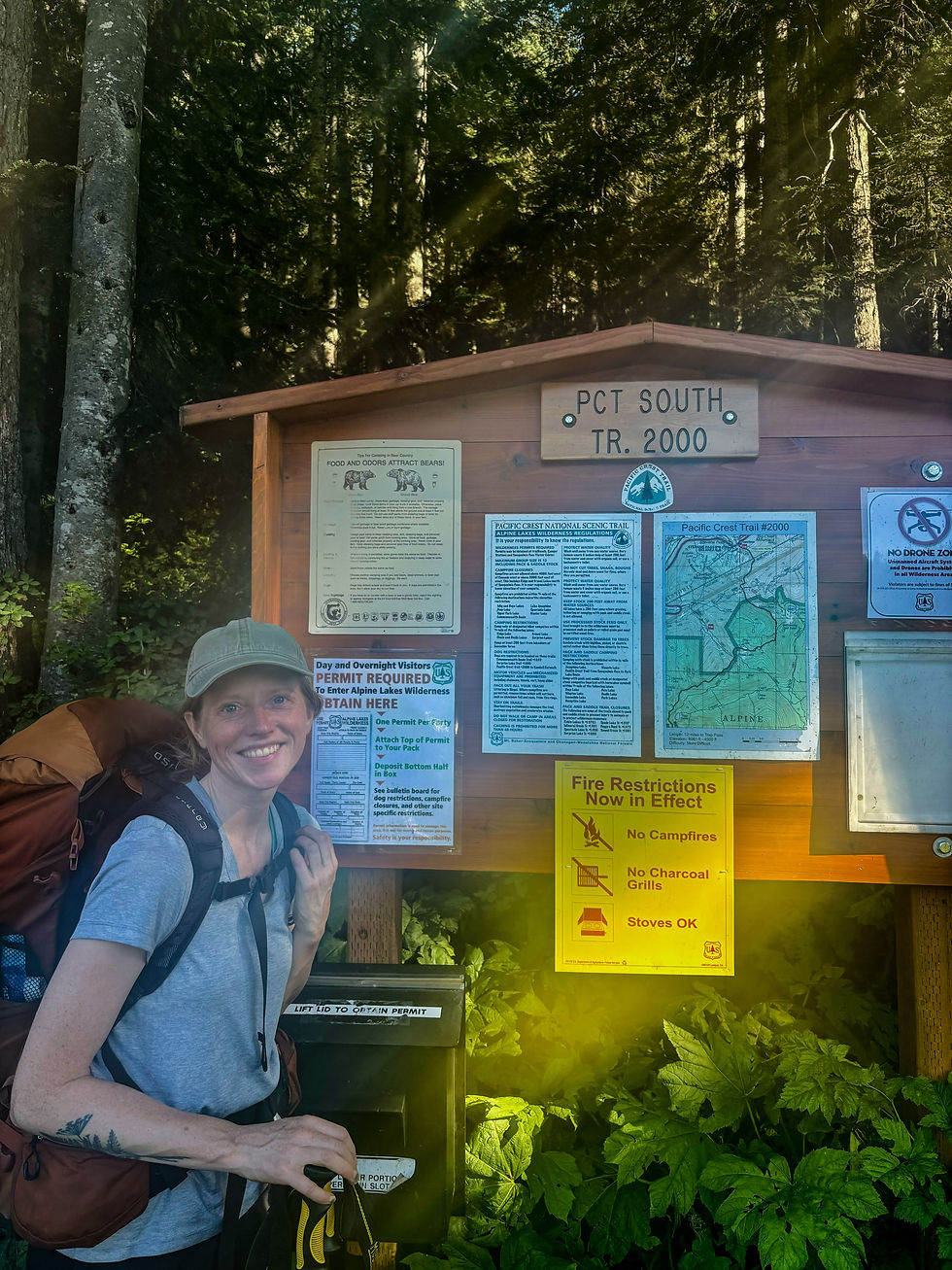
The section of the PCT labeled "J" is a 70-75 mile stretch in Washington from highway I-90 to Steven's Pass, twisting and turning around some of the most pristine alpine lakes in the area. With 16,000 feet of elevation change, this section is the perfect balance of beautiful views and challenging climbs, an idea area for backpackers hoping to grow their skills. In 2024, I solo-hiked this section in 6 days, and this a breakdown of my day-to-day itinerary.
Day 1 - Trailhead to Gravel & Ridge Lake (7.5m)
One of the great benefits of this section of trail, is its accessibility - just pull off one of the biggest highways through Washington and you're there! Since this was the longest hike I had ever planned for myself, I made sure I kept the first day simple: 7 miles, obvious campsite, easy bail-out if needed.
The beginning of the trail includes classic washington terrain, sloping switchbacks surrounded by gorgeous trees and pine-covered ground, interrupted, occasionally, by rocky boulder fields and talus.
The highlight of this day is Kendall Katwalk, with views starting to open up just after mile 4. Kendall Katwalk is a well-known section because of its narrow trail with dangerous drop-offs and incredible views of the surrounding peaks. Another mile forward and you will find yourself beside ridge lake and signs for gravel lake. There are established campsites scattered on either side of the trail here, but know that hiking down to Gravel lake is not worth the effort of the scramble. Staying near the trail is simpler and you can access water to filter at Ridge lake.
Day 2 - Gravel & Ridge Lake to Spectacle Lake (10m)
Though you will be able to see alpine lakes every moment you travel this day, water sources will, surprisingly, be difficult to access, so planning ahead is important. The trail from Ridge lake to Spectacle lake is full of ridge walks and easternly views as you meander around various peaks that make up the Central Cascades. This day will include several talus-filled sections as you cross Chikamin Pass before making your way down a long section of switchbacks to Parks Lakes. There is camping and a reliable water source at Park Lakes for those looking to stop here, though most hikers will continue making their way to the well-known gem of this trail: Spectacle Lake. This includes continuing past Park Lakes and beginning a short but steep section of switchbacks that lead you to a jaw-dropping overview of Spectacle Lake. Here you can enjoy your last snacks, but don't dream of dinner too early, because this steep section down to the lake will need all your attention.
*Note: If you are prepared with water sources, as I was, there are 2-3 small campsites at this section "overlooking" Spectacle Lake. Having already camped there, and knowing it would be quite crowded, I was able to pack extra water, and enjoy my night at this quieter location.
Finally, you will find yourself at, what might be, your most beautiful campsite during this whole trip - so enjoy! Campsites can be found all around the edges of either of the lakes. This is a very popular backpacking location, so you may need to prepare for lots of other hikers. For those with a bit more energy in them, there are also more private campsites around 1 more mile below Spectacle lake near the waterfall.
Day 3 - Spectacle Lake to Copper "River" Lake(12m)
Today includes a lot less alpine lakes and a lot more ups and downs, though there will be plenty of water sources along the way. Your morning will be almost entirely a descent through a valley beginning to come alive, again, after a wildfire from 2009. One large obstacle from today will include Leman "creek," though hikers should know it is much more than a creek! In 2024 the Lemah Meadows route (the classic PCT section) was closed, but only required a short circumvent on Pete Lake trail. The crossing is the bigger concern, with cold water that reached past my knees even in August and is very cold. Hikers should have a plan when attempting this part of the trail.
Past the crossing you are in Lemah meadows, a beautiful section full of alpine flora and fauna, with campsites to stretch out for lunch and perfect water sources. Eventually, hikers will begin another ascent up and around Waptus Pass. Originally I had scouted an unnamed lake at the top of this pass as my end goal, but by day 3 I had begun to build confidence (and been inspired by the relentless PCT hikers around me) and kept hiking just a bit longer. However, this unnamed lake was just off the trail and was a perfect spot to stretch, enjoy a snack, and get a bit more water. There were at least 2 other unnamed lakes passed in this section of the Escondido Ridge where I saw other hikers turn off to make camp before I located my stopping spot at Copper "River" Lake. Copper Lake is not a lake, and hikers should not expect much except a secluded basin with a small stream running through and 2 barely marked campsites. This is a good location to stop if needed because the trail immediately after begins another climb up and then down before other campsites and water sources can be found.
Day 4 - Copper Lake to Cathedral Pass (17m)
By day 4 I was obsessed with thru-hiking, and my mileage for this day shows my excitement to push myself. It also snowed this morning as I packed up my tent, so the extra miles kept me warm! Immediately after Copper Lake is a small but steep ascent where 1-2 small campsites can be found just off the trail for late-night hikers, before the descent down to Waptus River. You will get a gorgeous view of Waptus Lake and the surrounding peaks before spending the rest of your morning going downhill. Thankfully there is a wonderfully built bridge - so no more water crossings. This is also a great stopping point for filtering water. Moderate switchbacks up and down are scattered through this day of hiking, with some ridge sections in between, fill of wildflowers and local peaks. The last 2 days have included much more West to East hiking, but today the trail finally begins to point straight North, bringing different views and the promise of the end of the section.
Eventually, hikers will pass a sign that points to Deep Lake or to continue along the PCT to Cathedral Pass. Deep Lake includes 1-2 small campsites around the lake and 2-3 campsites nestled further back in the trees close to the intersection. This is a great stopping point and Deep lake is an incredible hidden gem along the trail. However, hubris got the better of me, and I found myself bypassing this beautiful location for more miles.
Immediately after Deep lake comes a steep ascent toward Cathedral Pass a few miles long. Once at the top of Cathedral Pass, enjoy the moderate views, as this will be the highest point of your trek. Views of Cathedral Rock and maybe even a view of Peggy's pond if you have more energy will welcome you, but be careful with the weather overnight since you are so high up.
Day 5 - Cathedral Pass to Glacier Lake (15m)
I woke up this morning to a frozen tent, thanks to my elevation, but also a gorgeous view. This section of the trail will include more, incredible ridge walks and non-stop overlooks of pristine, alpine lakes - this is where the Alpine Lakes Wilderness truly lives up to its name! While descending from Cathedral Pass, even in August there were several streams running down to various alpine lakes and the Cle Elum River that I was able to use as water sources. Views of Granite mountain and Thunder mountain might even be usurped by glimpses of the well-known Colchuck and Dragontail Peaks, and even Mt. Baker all the way to the North if you are lucky on a clear day.
Once climbing up and over Deception Pass, hikers will arrive at Deception Lakes and Daisy lakes - a smattering of small, charming lakes that are perfect spots to stretch out and enjoy a lunch or snack break. If necessary, there are also camping spots at all of these locations for the early-stopping hiker. Though, be warned, if hiking in July, the small lakes and lowlands are perfect spots for mosquitos to gather and may not be too enjoyable!
One last, long ascent immediately follows Deception Lakes, and a very rocky section of switchbacks down-down-down before hikers find themselves surrounded by gorgeous boulders marking the beginning of Glacier Lake. Campsites can be found scattered around the area, several of them nestled amongst the boulders for those who need protection from bad weather, several campsites situated easily amongst the trees if you need cover, and a handful of campsites near the lake. Getting to the lake requires a very short but slightly steep descent, but hikers will find a gorgeous lake and small streams of water to filter. More campsites can be found for hikers willing to trek a bit to the right and left (I found an incredible one about .25 from the lake trail to the left, hidden a bit from view.
*Note: unless you are paying particular attention to elevation maps, it seems as though surprise lake could be a good option to trek down to for more privacy, however that is not the case! After just a few steps, hikers will find an incredibly steep and slightly dangerous path down to the lake which is definitely not worth the work!
Day 6 - Glacier Lake to Stevens Pass (13.5)
You've made it to the final push! Thankfully, this is a mostly, moderate hiking day until the last few miles, so enjoy yourself and soak up the views this morning. Starting in the morning with a moderate ascent of switchbacks through gorgeous trees, you will eventually work your way back out to ridgewalks, once again overlooking numerous alpine lakes and wildflowers. You may even be lucky enough to peak the elusive looming north which is part of the PCT section K. Similar to yesterday, make sure to stop and enjoy the alpine lakes you pass along the way: Trap, Hope, and Mig lake all have easy entries near the trail where hikers can slow down and enjoy a view with their snack or lunch. I especially enjoyed Hope lake and it was the perfect lunch spot for me.
Hikers may notice once they pass Mig lake, that there is now more descent than ascent happening, and they should prepare for the mental push that is these last few miles. Though there are still ups and downs and gorgeous views, hikers should be prepared for the steep descent that is eventually needed to get all the way down to Steven's Pass Trailhead. Eventually, hikers will find themselves mostly in trees and the lack of views does not help the relentless downhill hiking. Stopping at Josephine Lake and Lake Susan Jane can be a relieving stop and adjustment before continuing down-down-down. Eventually below hikers will be able to spot ski lifts and small flashing cars from the highway - but don't get ahead of yourself! the switchbacks through the ski area will surprise you, as they go on much longer than you expect. However, it is all worth the miles as hikers will end right at Steven's Pass Ski Resort where you can order a much deserved burger and fries from Bull's Tooth right there at the resort, or enjoy one of the many Restaurants along Highway 2 on your way back to Seattle (I personally stopped at Smokey's Restaurant and Brewery in Skykomish and loved it!)
Lessons and Growth Opportunities
As my first thru-hike, my first section hike, and my longest overnight backpacking trip, there was so much I learned from this opportunity that I have taken into my current adventures.
Start Short: though my mileage and confidence grew, I was grateful for my slow start. It would have been easy to guilt myself into going farther or being influenced by other hikers. However, staying smart the first day or two is what is needed for you to eventually outgrow your expectations and get stronger.
Weather: There was no way I could have known it would snow during my week - even the PCT'ers I chatted with were thrown from this sudden change. You will not know everything that will come, but you must be prepared to take it on. Whether that is extra layers, mental grit, or extra calories, be prepared for the unexpected.
Overestimate water: This area of WA is known for its alpine lakes, and yet there were at least 2 days when water felt "limited." I learned quickly to overestimate water and, though your pack weight gets heavier, your body will thank you.
Campsite flexibility: this was my biggest concern going into a thru-hike. Do I pick where I will stop each night? Do I let the trail decide for me? It is really a mix of both. I am glad I generally understood the "big picture" of my trail and where I should be aiming to stop each night. However, I ended up hiking much faster than I expected, so campsites changed. I now know of more apps like Caltopo and Farout where there is more discussion on specific locations of camps, water, etc. I would advise hikers to always pay attention to elevation during their hikes to understand where camps will and will not be (AKA: there probably won't be a campsite along a long stretch of switchbacks unless you are very lucky, but there will almost always be camp locations below or at the top of passes and near lakes and water sources.
Solitude: There was quite a big jump for me, mentally, between being alone for 2-3 days for a backpacking trip and for 6 days. Solitude is one of the main reasons I love backpacking, but I even needed to give myself some grace and adjustment time to get used to that many days alone. Though, in a place like Washington, you are almost never alone, as most trails have other hikers on them - so enjoy it whenever you cross paths with another!
Camp chores: When you begin to extend your hiking miles, it may be helpful to know how long it usually takes you to do camp chores. For instance, even when I try to go fast, my morning routine always takes longer than I expect. This was an important thing to notice when I began to go 15, 18 miles in a day, so that I knew what time I needed to get started in the morning.
Additionally, the more days you are out, the more likely you will encounter bad weather. Getting familiar with how to pack your bags when your tent or gear is wet is a great skill to build. This was the first trip I needed to stop during several lunches to air out my tent and dry my rain fly, which made packing and repacking more interesting. Yay for growth opportunities!
Pre-trip Crashout: Yes, we all have it. Be kind to yourself and know that all around the world are hikers having panicky moments the night before their big trip. I had a huge crashout the night before this trip, and I wish I would have been kinder to myself in that moment. I'm glad I didn't give in or pause my trip, but it was important to let that anxiety out and release before the trip began the next day. It's perfectly normal, and you can cry and do hard things all at the same time!
You've got this!
For more outdoorsy hiking inspiration, follow me on IG!


Comments